You’ve probably noticed that when comparing individual partnerships, even with seemingly similar initial conditions in the same field, results can vary significantly.
Success can be easily attributed to luck. “They just got lucky, and we didn’t — that’s life, it happens.” This approach allows one to avoid responsibility, relinquish agency, and succumb to the whims of fate. The effectiveness of this mindset is zero because, within this framework, it is impossible to conduct a meaningful review of past mistakes. How can you imagine an analysis with such an approach? “Let’s figure out at what stage luck abandoned us. Who’s to blame, and what actions were missed to attract and retain it?” Absurd, right?
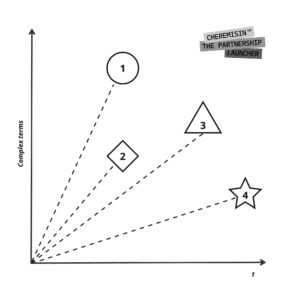
Scenario planning as a formalized framework emerged in 1962 and has been effectively used in corporate and governmental management ever since. Even exploring the most unlikely scenarios helps a partner group to coordinate actions, identify business strengths and weaknesses, and highlight key areas for immediate focus.
Scenario planning allows for maintaining control over the situation even in the face of the most adverse and unlikely events because you have already agreed on and understand your course of action. You have mentally played out the scenario, understood the logic of behavior, and assessed the necessary resources and their allocation. Most importantly, in a critical moment, you don’t need to negotiate or discuss how to act, saving you time and energy that might be needed for other tasks under stress. You reach a consensus in advance regarding the feasibility of certain actions. In complex and sudden situations, acting rationally becomes more challenging, emotions may overpower common sense, and reaching an agreement to act cohesively might fail. In business partnerships, you can undoubtedly take control and overpower a partner, but such an approach is unlikely to foster cohesion and ultimately lead to success.
I will give an example of how the approaches of the authorities in Chicago and New York differed in responding to threats in the early phase of the COVID-19 pandemic. Making decisions about city lockdowns in totalitarian states is straightforward: the enforcement apparatus works efficiently, without regard to elections or political costs. In democratic societies, it’s different: elected governments must rely on public opinion as the main factor ensuring reelection. It’s an endless game: if you acted correctly, you’re a hero; if not, you’re politically finished.
To understand the development logic of events, it’s important to note that the epidemiological curve of disease incidence is exponential, and in its initial phase, there is slow, insignificant, and non-alarming growth. There is no formal reason to scream, “Everything is lost, lock people in their homes.” If it turns out that such a decision was unjustified and the governor who made it was a panic-monger, their career could end. Playing this game, the New York authorities missed the moment, the incidence curve shot up, and everyone was locked down, but it was too late, and the healthcare system couldn’t cope with the surge of patients—collapse.
Chicago was luckier in this situation. A group of scientists, who understood the principles of epidemic and pandemic dynamics, led by Professor of Bioengineering Sergei Maslov, managed to reach the rector of the University of Illinois, explained the consequences of inaction, and justified their viewpoint—that quarantine should be introduced as early as possible. The rector of a large university is a figure of influence at the state level, capable of reaching the governor directly. As a result, quarantine in Chicago was introduced much earlier when it seemed like panic, and people were walking the streets “like nothing happened.” The burden on hospitals was significantly lower than in New York, and the flow of patients was stretched over time, allowing the system to hold. The governor took a significant political risk but ultimately was right.
Returning to partnerships, I have only one question: why do we need such stress in business? Considering the above example, let’s look at how events can unfold in two scenarios: there is no action plan, and there is an action plan.
In the first case, partners need to assess the situation. Even if they are skilled managers, possessing complete information and making decisions like trained American fighter pilots using the OODA Loop system: Observation, Orientation, Decision, and Action, it will still take a lot of time to coordinate actions. As in the case of New York, decisions may be made too late, especially since there is always a time lag between decision and action.
In the second scenario, with a pre-played scenario, an action plan, mental coordination, and an understanding of control points and response rules, you have a racing car with a warmed-up engine, brakes, and tires, a full fuel tank, a clean windshield, and a driver just waiting for the “start” command.
Summary: luck and talent help you win once, but system and discipline help you win consistently. The quality of partnership relations and business results are inextricably linked. Scenario planning is a system, and as we know, a system always beats both luck and talent.