In the course of joint activities, situations inevitably arise when partners perceive events differently, assign them varying degrees of importance, and give different assessments. Such differences can cause disagreements and hinder goal achievement.
To overcome disagreements, it is important for partners to understand that each of us has a unique set of perceptions about the present, past, and future. Everyone has their own baggage of behavioral stereotypes. Agree, when a former top manager from the corporate sector and a startup entrepreneur who has never worked “for the boss” enter into a partnership, their ideas about what is proper and their approaches to implementing business tasks will be very different. In general, there is no absolute clarity and objectivity set in stone. There are various worldviews formed by our consciousness, which determine our reactions, thoughts, and associations, often unlike those of others.
Worldviews may differ, but if these differences allow partners to act successfully and achieve agreed goals, it means that they have adapted to each other and to the reality of business.
The opposite situation occurs when partners face problems due to mismatched worldviews and suffer from this. This does not mean that the world, business, or the partnership itself is bad or unviable. It indicates the partners’ maladaptation and their inadequate perceptions of the joint business and each other. The gap between reality and their individual perceptions of it is excessively large. Synchronization tools are needed, not at the level of describing the current situation, but at the level of individual perceptions of the norm.
The more complex the business, the more complex the partners’ perceptions of it. Without proper synchronization between partners, the gap in their perceptions of the actual state of affairs in the business will widen, plunging them into the abyss of neurosis. The number of people in business partnerships with psychological problems is significantly higher than among those who run a business alone. Partners have an additional point of control and constraints in the form of the partner’s presence, on top of the entire spectrum of tasks and issues. In such situations, the partner may be perceived as a burden that prevents them from taking off and spreading their wings.
However, there is good news. If partners realize that their worldview is not reality but merely a set of stories and perceptions about it, and understand that their joint results depend on coordinated actions and quality synchronization of worldviews, formalized as partnership agreements, it means they can consciously build a business together. This leads to drastic changes in their actions and fate.
Business goals, the likelihood of achieving them, and the methods of doing so directly depend on the quality of agreements between partners. Partnership is a strategic asset of the business co-owners. Ensuring the quality of partnership agreements is a separate skill that needs to be developed. Without it, one cannot rely on self-organization and autogenesis of quality, comprehensive, and strong partnership agreements. Agreements are not like mice; they do not come into being on their own; they need to be purposefully worked on.
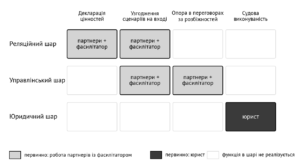
One of the ways to synchronize partners can be a partnership session, conducted either by the partners themselves, which rarely yields results, or with the involvement of an experienced specialist. A partnership session is a procedure of answering structurally posed questions from a third party. Partners do not answer each other’s questions, which, believe me, almost always causes tension and even repels colleagues, but together they seek an answer to the question posed by the facilitator.
In the process of the session, the partnership becomes objectified, tangible, endowed with the qualities of a physical object, and the ambitions, goals, and understanding of the value of doing business together are reloaded.
In our life, what we believe in is real. If business partners believe in the power of partnership agreements and are ready to invest in them because partnership is a strategic asset, they can build a joint reality. The entire internal dynamics of the business will unfold exactly as the partners wish.
The task of the partnership session is not to create absurd fantasies, but to form a mutually attractive image of the business and the partners in it. In the process of the partnership session, it is important for partners to show each other how they want to see their business and themselves in the boldest and craziest dreams. Why? Understanding important details in each other’s worldviews that they didn’t know or didn’t pay attention to before, partners can see opportunities where there were previously obstacles, hear each other, and build a bridge to the intended goal. If you know that your partner actually wants to build a cottage in the woods, then one day just by sending a picture of a house in the woods, you can become closer and more reliable in their eyes because you care about their interests.
The result of the partnership session is a partnership agreement that formalizes everything you have agreed upon. The quality of the agreement is determined by how safe you feel, how deeply you have worked through future scenarios, and how many complex questions you have found a satisfactory answer to. The partnership agreement is the most important point of attention for partners, a strategic asset that allows overcoming differences in worldviews and developing the partnership story into a success story.