The fourth article in a series based on the paper “Agreement Between Partners: Three Layers, Four Functions, and the Limit of Legal Formalization.” The previous one took apart the three layers of a partnership document. This one answers the question of why partners need an agreement if they already have a charter.
Why an agreement, if there is a charter
A question partners ask almost every time: “We have a charter, and we will have a corporate agreement. Why one more document?”
The question is a fair one if you look at the document through a lawyer’s eyes. For a lawyer, a document exists so that, in a dispute, it can be presented in court. Anything a court will not enforce is, from that angle, surplus.
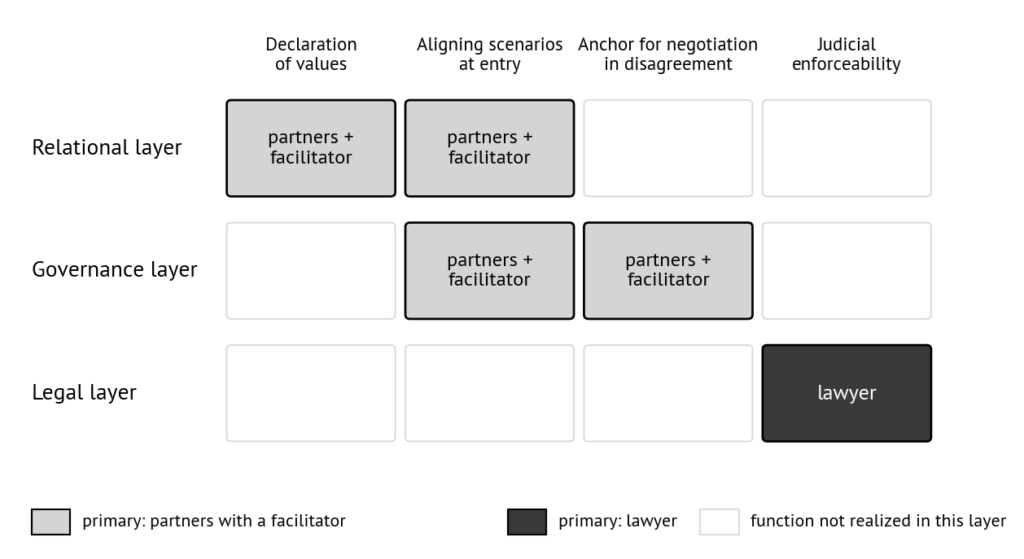
But an agreement between partners does four different jobs, and only one of them is a job for the court. The other three are done before any conflict and without the state. The charter and the corporate agreement cover the fourth. The first three, the partners can cover only themselves.
Below are the four functions in turn. For each: what it does, what it looks like in practice, and which researchers described it earlier.
Function 1. A declaration of values
The first function is to record what the partners consider right and what is unacceptable to them. It is the reference point for interpreting everything else in the document.
An example. Two partners open a manufacturing business. One considers it normal to work weekends when an order is on fire, and expects the same of the other. The other believes weekends belong to the family, and orders should be planned so that they do not catch fire. Neither sees this as a topic for a document: to each, his own rule is obvious. Six months later, the first accuses the second of not putting himself into the business. The second does not understand what this is about: he is doing everything they agreed on.
A written declaration of values would not have made either of them change a habit. But it would have made it visible that the habits differ, and it would have forced them to agree before the difference turned into a grievance.
This function rests on two concepts.
In 1989, the psychologist Denise Rousseau described the psychological contract: an employee’s belief about what they owe the organization and what the organization owes them. It always exists, and it lives outside the text of the employment contract. The same operates between partners: each has a picture of their mutual obligations, and it does not match the other’s picture until it has been discussed.
In his 2015 book “The Expressive Powers of Law,” the legal scholar Richard McAdams showed that law works not only through the threat of sanctions. The very text of a rule tells people what others expect and gives them a point around which to coordinate their behavior. A declaration of values in a partners’ agreement works the same way: it compels nothing, but each partner knows what the other expects and can point to it.
Function 2. Agreeing on future scenarios
The second function is to talk through how the joint business will develop and how the partners will act if one of the events nobody wants to think about occurs: one of them leaving, death, divorce, a serious mistake that cost money.
An example. Three founders are preparing to register a company. At a meeting they are asked what happens if, a year from now, one of them wants to leave. Two answer at once: the others buy out the share under an agreed formula. The third stays silent, then says he is not ready to give up his share under a formula, because he is the one who brings in the clients. It turns out he saw himself not as a partner but as an owner with two assistants. This came out before registration, not a year later in court.
That is how this function works. Having to formulate a scenario and sign under it makes each person stop and picture what will change in their life once they enter the partnership. If someone is not ready for a partnership, it shows while the agreements are being worked out.
This function rests on the legal scholar Lon Fuller’s 1941 article “Consideration and Form.” Fuller described three functions of contractual form. Evidentiary: form leaves a trace, and a year later you can reconstruct exactly what was agreed. Cautionary: having to formulate and sign creates a pause in which a person realizes they are taking on an obligation. Channeling: form separates an obligation from a conversation. The second function of a partners’ agreement is Fuller’s cautionary function.
The second source is the 2014 review “The Many Futures of Contracts” by Donald Schepker and his co-authors. They showed that for decades the research on contracts saw them above all as protection against the other party’s opportunism, and proposed a wider view: a contract is also a tool of coordination, who does what and in what order, and of adaptation, how the parties change the terms when circumstances change. Agreeing on scenarios at the outset is coordination.
Function 3. A footing in negotiations when partners disagree
The third function switches on when the partners disagree. In a dispute they rely on what they themselves worked out, wrote down, and signed, not on the law and not on who remembers what.
An example. Two years after the start, one partner wants to hire his brother as finance director. The other is against it. The conversation starts with emotions: “You don’t trust me,” “You’re dragging your family into the business.” Then someone opens the agreement. There is a clause: relatives of partners are hired only with the consent of all partners, and only for positions without access to money. The dispute does not disappear, but it changes shape. Now it is not about trust but about whether a clause both of them signed should be revisited.
This function is based on two ideas.
In their 1979 article “Bargaining in the Shadow of the Law,” Robert Mnookin and Lewis Kornhauser showed, using divorce as their case, that parties settle outside court but with an eye to how a court would decide. The law casts a shadow over the negotiation. In a partnership, the shadow is cast not by the law but by what the partners themselves agreed and recorded.
In his 1960 book “The Strategy of Conflict,” Thomas Schelling described focal points: options both sides regard as obvious and therefore rely on without discussion. A written agreement becomes such a point. The negotiation starts not from a blank sheet but from what has already been agreed.
Adaptation, in Schepker’s sense, belongs here too: the partners revise the terms starting from what they have already agreed. Hence a rule worth fixing separately: amended agreements are re-signed. Otherwise the reference point goes stale, and in a dispute each partner cites their own version.
Function 4. Enforceability in court
The fourth function is the ability to turn to the state for enforcement. It works only with the part of the document that specifies who must do what, for whose benefit, or what they must refrain from doing (Article 509 of the Civil Code of Ukraine). This is the legal layer, the subject of the previous article in the series: “Three Layers of a Partnership Document: Relational, Governance, Legal.”
In Fuller’s terms, this function is made of two: the evidentiary one, because there is a trace that can be presented to a third party, and the channeling one, because form separates an obligation from an intention.
This is the function that calls for a lawyer. The charter, the corporate agreement, the share purchase agreement, security: these are forms the state will enforce. Translating an agreement into such a form takes knowledge of the law.
Law serves only one
The key observation of the model: law serves only the fourth function. It does not produce the first three, even though the format may look alike: clauses, numbering, signatures.
The first three functions work from the first day of the partnership and until a conflict. The fourth switches on when the conflict is already there. And it is the first three that determine whether the partnership ever reaches the fourth.
Hence the answer to the question from the opening. The charter and the corporate agreement are needed: without them there is no fourth function. But they do not do the other three jobs. Partners who believe “we have everything formalized” have the fourth function and lack the first three. When a disagreement arises, they have nothing to lean on except the court.
What this means for partners
Four functions are four questions to ask of your document.
Does it say what is unacceptable to you? If not, the first function is missing.
Have you talked through what you will do if one of you wants to leave, falls ill, or makes a mistake that costs money? If not, the second function is missing.
Do you go back to the document when you disagree, and do you re-sign changes? If not, the third function does not work, even if the text exists.
Has a lawyer formalized the part a court is supposed to enforce? If not, the fourth function is missing, and the document remains an agreement without enforcement.
The first three questions are closed by the partners’ own work. The fourth, by the lawyer’s. Confusing them means either expecting from the lawyer what the lawyer does not do, or expecting from the agreement what it does not give.