The previous article in this series, “The Cost of Error: What the Road Through Court Costs and Why Winning Is Not the Same as Collecting,” was about what a dispute costs once it enters the state machinery. The partners who end up there are the ones who did not have sound agreements. The sign of sound agreements is that the partners resolve conflicts without going to court.
A partnership agreement is weak where the partners have not reached agreement between themselves. I work with agreements between partners, and my position is this: partners must reach a deep, sound agreement between themselves, ideally with a professional intermediary, a facilitator, to rule out the scenario of “resolving the conflict in court.” Counting on lawyers and the court to rescue the partners is a mistake, and the cost of that mistake is known before any dispute: according to estimates by experts from 26 EU countries, one per country, the same hypothetical commercial dispute costs on average €10,449 in court against €2,497 with successful mediation (the study for the European Parliament “Quantifying the Cost of Not Using Mediation,” De Palo, Feasley, Orecchini, 2011). In Ukraine in 2025, money was actually recovered in about a third of completed enforcement proceedings across all kinds of debt, from child support to fines (Opendatabot data).
Which five signs reveal the weak spot of a partnership agreement
A partnership agreement can be checked in ten minutes against five signs. Four signs show what the partners have not agreed on; the fifth shows a mistake in how the legal part was done.
| Sign | What the sign means | What to do |
|---|---|---|
| 1. A standard template was signed; scenarios were not discussed | There are no agreements: the document has nothing to record | First work out agreements scenario by scenario, then put them into a document |
| 2. Provisions are written as intentions and values | The agreement has not been taken as far as action: it does not say who does what and when | Next to each value, write down the action, the deadline, and the consequence of non-performance |
| 3. “If anything happens, we will go to court” as the plan | The partners rely on the court, although winning in court does not yet mean collecting what was awarded | Agree on how to resolve disputes between yourselves; assess the cost, duration, and enforceability of court separately |
| 4. No procedure for exit, share valuation, or deadlock resolution | The hardest scenarios have not been agreed on, and the lawyer has nothing to formalize | Agree on these scenarios, then formalize the enforceable part in a corporate agreement |
| 5. One lawyer drafted the document for both partners | Neither partner has an adviser of their own; in a dispute between the partners, this attorney must withdraw | Each partner gets their own attorney |
The order of the signs follows the order of the work: first the partners work out their agreements, ideally at a partnership session; then a lawyer formalizes the part of the agreements that the state is to enforce. A partnership session is a meeting of the partners with a facilitator at which the partners work out their agreements. In this series, agreements between partners are divided into three layers: the relational layer is the partners’ values and expectations, the governance layer is authority, money, and decision-making procedure, and the legal layer is what the state will enforce. For details, see the article “Three Layers of a Partnership Document.”
1. A standard template was signed; scenarios were not discussed
A standard template signed without discussing scenarios means that the partners have not reached agreement: there are no agreements on scenarios, and the document has nothing to record. A template is dangerous because it creates the impression that the relationship has been formalized.
In the text, the sign looks like this: the document would suit any company, and it contains no roles, amounts, or deadlines specific to this business. Authority, money, deadlock, and the entry and exit of partners are covered in general terms or not at all. Decisions stall because no one knows who has the final say. An event that was never discussed has to be dealt with when the partners’ interests have already diverged.
What to change: first work out agreements scenario by scenario, then put them into a document. A scenario is an event that will happen sooner or later, together with the question of what the partners do when it does. Examples of scenarios:
- one partner wants to reinvest the profit in growth, the other wants to take it out;
- the partners disagree about a large expense, and the decision has stalled;
- one partner is unable to work for a long time because of illness;
- a partner has decided to leave the business;
- a new partner is joining the business;
- a partner has died or is divorcing, and the family claims the partner’s share.
An agreed scenario looks like this: “If we disagree, the decision is postponed for seven days and taken to a face-to-face meeting. If there is still no agreement after that, we bring in a third party chosen in advance” (a typical provision from the article on the three layers).
A facilitator also takes the partners through the scenarios they would not raise themselves. A scenario counts as agreed when each partner is ready to sign under it. The difference between discussed and agreed is explained in the article on the signature.
2. Provisions are written as intentions and values
Provisions written only as intentions and values mean that the agreement has not been taken as far as action: the text does not show who does what and by when.
In the text, the sign looks like this: “we value openness,” “we act openly,” “we support each other,” and not a single sentence about actions. The values themselves are needed: they state the partners’ expectations out loud. But without a recorded action, each partner understands “openness” in their own way. A court will not enforce such a provision either: a court recognizes as an obligation only a provision that is aimed at rights and obligations and has a determinable subject matter, feasibility, and lawfulness (Articles 202, 509, and 638 of the Civil Code of Ukraine).
What to change: next to each value, write down the action, the deadline, and the consequence of non-performance. On openness: “Each partner provides the listed information every quarter and reports to the other partners at the quarterly partners’ meeting” is already an agreement that can be checked.
3. “If anything happens, we will go to court” as the plan
The plan “if anything happens, we will go to court” is a mistake: court is expensive, takes a long time, and does not guarantee that what was awarded will be collected. Behind the word “court” stand the three steps of enforcement: the judgment, the enforcement document, and the recovery. At each step, third parties decide the fate of the case.
In the text, the sign looks like this: the section on disputes consists of one sentence, “Disputes are resolved in court” (typical wording, composed as an example). The cost and duration of the court route are estimated in two reports for the European Parliament.
| Indicator, EU average | Court | Successful mediation | Source and sample |
|---|---|---|---|
| Cost of a hypothetical commercial dispute | €10,449 | €2,497 | De Palo, Feasley, Orecchini, 2011: estimates by experts from 26 EU countries, one per country |
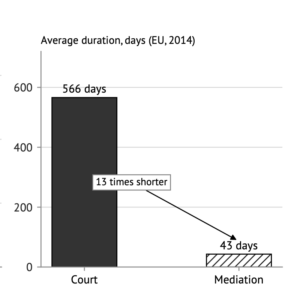
| Duration | 566 days | 43 days | Report by the same group, 2014: court from the Doing Business 2014 ranking, mediation from 816 expert responses |
The court route in a model commercial dispute in the EU is about four times more expensive and about thirteen times longer than successful mediation. Both reports describe commercial disputes in general; they say nothing about disputes between partners specifically, but the example is vivid and gives grounds for drawing analogies to disputes between partners.
What to change: write into the agreement a procedure for resolving disputes before court: who calls a meeting and within what time, which third party the partners bring in if there is no agreement, and who pays for that party’s work. Court remains the last step. The steps of enforcement are examined in the article on the three steps of enforcement, and the numbers, with their caveats, are in the article on the cost of error.
4. No procedure for exit, share valuation, or deadlock resolution
An agreement without a procedure for exit, share valuation, and deadlock resolution means that the partners have not agreed on the hardest scenarios, and the lawyer has nothing to formalize. If one of the partners chooses the legal route to settle a dispute, the law will fill the gaps in the agreement with rules the partners never chose.
In the text, instead of these procedures, there is often a single sentence such as “a partner has the right to leave the business after notifying the others” (typical wording, composed as an example). As long as the partners get along, the gaps are not visible.
What to change: agree on three things. Exit: how much notice a partner gives the others and how the partner hands over their work. Share valuation: by what formula the share is valued and within what time it is paid for. Deadlock: what happens when there is still no agreement after a meeting with the third party. Then the partners decide which of these agreements the state is to enforce. The enforceable layer is the part of the agreements that the state can enforce by coercion. A lawyer formalizes the enforceable layer in a corporate agreement, the Ukrainian counterpart of a shareholders’ agreement, which is concluded in writing and only by the members of an already existing company (Article 7 of the Law of Ukraine “On Limited and Additional Liability Companies”).
5. One lawyer drafted the document for both partners
If the partners want legal armor, one lawyer for two is a mistake: each partner must have their own attorney. Without the written consent of both clients, an attorney may not simultaneously represent parties whose interests conflict, and if a conflict arises in the course of the work, the agreement with the attorney must be terminated (Article 28(1)(7) of the Law of Ukraine “On the Bar and Practice of Law”; Article 9 of the Rules of Attorney Ethics).
The sign is visible from the history of the document: one lawyer listened to both partners and prepared a text “for us.” The partners expect that in a dispute this lawyer will help, because the lawyer knows all the agreements. In a dispute between the partners, an attorney who worked for both must withdraw, and each partner is left without an adviser exactly when an adviser is needed.
What to change: each partner gets their own attorney, from firms that compete in the market. For details, see the article “One Lawyer Cannot Defend Both.”
What this means for partners
The main work is to reach agreement between yourselves, ideally with a facilitator. A template, values without actions, and unagreed exit scenarios show that there are no agreements. No document will record what the partners have not agreed on. The facilitator helps the partners work out their agreements; the lawyer formalizes the enforceable part.
Counting on lawyers and the court is a mistake. Court is expensive, takes a long time, and does not guarantee recovery. A lawyer formalizes agreements the partners have already reached.
Legal armor comes after the agreements, and each partner gets their own attorney. The enforceable part is formalized when there is something to formalize, and each partner reviews it with their own attorney.
The diagnostic table is taken from the author’s paper: “Partnership Agreement: Three Layers, Four Functions, and the Limits of Legal Formalization.”