Three layers of an agreement between partners, its four functions, and the line where the lawyer’s work begins
Two partners start a business. They are friends, they are on the same wavelength, and they are smart people, so they go to a lawyer with a request: “Make it all official for us.” The lawyer drafts the charter and the corporate agreement. Signatures, registration, champagne: a brilliant future awaits.
A year and a half later, reality arrives. One of them is convinced the business runs on their effort alone; the other is convinced they have been pushed away from the money and from day-to-day decisions. They open the folder with the documents and find that not a word in there is about this.
The lawyer did the job, and there are no questions for the lawyer. The problem is how exactly the partners reached their agreements, and whether they reached any at all.
A cozy idea and three uncomfortable facts
The idea “let’s make it all legal and then work in peace” is cozy. The trouble is that it does not survive contact with practice.
Fact one. Conflict between co-owners is one of the main causes of business failure. When 49 venture capitalists were asked about 96 troubled companies in their portfolios, “problems in the team” was among the top three causes at 61 of them. That figure traveled the world as “65%” thanks to Noam Wasserman’s book The Founder’s Dilemmas.
Fact two. Researchers followed eight founding teams for six months and found that what triggered conflict was not the size of anyone’s share but the feeling that the shares had been divided unfairly. Not a number in a document. A feeling!
Fact three, the most uncomfortable one. Back in the early 1960s, Stewart Macaulay interviewed 68 businessmen and lawyers in Wisconsin. It turned out that when planning deals and settling disagreements, businesspeople hardly ever turned to the contract or the law, and they saw a detailed contract as a hindrance to the relationship: if something goes wrong, we will call each other, not the lawyers. Ukraine is no exception: of the problems people themselves consider legal, 4.8% reach a court (a survey of six and a half thousand adults, 2015).
Hence the conclusion my article, published on Zenodo, starts from: for the stability of a partnership, the legal form of the partners’ agreements is neither necessary nor sufficient. Then what is an agreement between partners, what is it made of, and where does the lawyer’s work end?
One word hides three different things
Language sets a trap for us, and English sets it more gently than most. What partners actually do is called reaching an agreement. What they get on paper is called a contract. Contract carries the legal frame; agreement covers both the understanding reached and the document that records it. That is why the standard phrase founders’ agreement is read by lawyers as a contract and by founders as the understanding between them.
I measured the trap across text corpora. In English books, contract and agreement are almost equally frequent, and agreement takes the verbs sign and reach almost evenly. In Russian, where the main measurement was made, the trap is stark: the common word dogovor, contract, occurs 12 to 23 times more often than dogovorennost, the agreement reached, and it attracts the lawyer’s verbs, conclude, sign, terminate, while dogovorennost attracts one verb: reach. Ukrainian sits in between: the same boundary between two words, but the word for the agreement reached is not rare, and the everyday verb domovytysia, to come to an agreement, is common.
What follows in practice? When partners say “we need a contract,” the word leads them to a lawyer before there is anything to formalize. So let us separate three things.
An agreement is the consensus the partners have reached on how they will act together: who does what, how decisions are made, what counts as a fair contribution, how the terms are revised, how a partner leaves the business.
A document is the written record of the agreements. Signed or not.
A contract, in the legal sense, is only the part of the agreements that concerns rights and obligations and can therefore be the subject of a lawsuit.
The Civil Code of Ukraine draws this line explicitly. Article 626: a contract is an agreement of two or more parties aimed at establishing, changing, or terminating civil rights and obligations. The genus is agreement. The contract is one of its species. So agreements that are not aimed at rights and obligations are not abolished by the law. They are simply not its subject. They are the subject of my article.
Three layers: what actually sits in a partnership document
Take a real document that partners worked out in a session and signed, and you will find provisions of three different natures in it.
The relational layer. Values, expectations of one another, the notion of a fair contribution and a fair share, what is acceptable and what is not, what the partners consider betrayal. An example from practice: “We do not argue in writing, only in person, or by voice over the phone if we cannot meet in person within the next three days.”
The governance layer. Powers and their limits, access to information and money, how decisions are made and deadlocks resolved, roles and their revision, how new partners come in, how partners leave, what happens on death, divorce, or incapacity. An example: “Each partner may approve expenses within their own area of responsibility up to amount X alone. Above that, only by joint decision, recorded in the chat. In case of disagreement, the decision is postponed and brought to a face-to-face meeting.”
The legal layer. Rights and obligations, security, evidence, remedies, enforceability. Everything that translates into the language of the charter and the corporate agreement (in Ukraine, the counterpart of a shareholders’ agreement).
The partnership session forms the first two layers and sets the task for the third. The lawyer is responsible for the third. This is not an argument about who matters more. It is a division of labor: the partners work out the agreements, the lawyer formalizes their enforceable part. A partnership agreement is the perfect brief for the lawyer.
Four functions, of which the law serves one
Why do partners need a document if a court will enforce only part of it? Because an agreement has four functions, and three of them work without any court at all.
Declaration of values. Every partner carries in their head a notion of what they owe the other and what the other owes them. Psychologists call it the psychological contract, and it lives outside any text. The section of the partnership agreement devoted to values makes part of that notion shared and explicit. It compels no one, but it says: this is how things are done here.
Aligning how to act in future scenarios. The partners talk through how they will act on an exit, a death, a divorce, a theft, a serious mistake by one of them. Having to sign under a scenario makes each of them stop and realize what rules they will be playing by in this partnership. If someone is not ready for the partnership, it shows while the agreements are being worked out, not as an unpleasant surprise three years later, when there is something to divide: profit and loss alike.
An anchor for negotiation when disagreements arise. In a conflict, the partners argue from what they themselves worked out and signed, not from the law. The conversation starts not from a blank page but from a point fixed in the document.
Judicial enforceability. The possibility of turning to the state for coercion.
The law serves only the fourth function. The first three work before any conflict and without the state, and it is they that decide whether the partnership ever reaches the fourth.
Not everything can be foreseen, and that is no reason to write more
Economists showed long ago that the parties cannot describe every future state of the world, so any contract is incomplete and its gaps are filled as the relationship unfolds. The more interesting part is this: a contract works as a reference point for expectations. If a partner believes they got less than they were owed “in spirit,” they do not respond with a lawsuit. They start performing their obligations formally, to the letter and not a step beyond.
An experiment in Zurich with 328 participants measured it: under a rigid contract, where the payment was fixed in advance, sellers delivered normal quality in 94% of cases; under a flexible one, where the buyer could set a price below what was expected, in only 75%. Resentment shows up first as sabotage and only later in court.
Two consequences follow. Conflict is born not from a breach of the text but from a divergence of expectations that never made it into the text. And the single most important clause of a partnership agreement is the agreement to renegotiate: on a date set in advance, or upon an event the partners have named themselves.
Scenario agreements are vaccines against known threats.
The agreement to renegotiate is the immune system for the scenarios nobody foresaw.
What a signature really does
A signature under a partnership document is usually taken for a legal formality. That is a mistake, and an expensive one. A signature does four things, and the legal one comes last.
Acknowledgment. By signing, a partner says: these are my agreements, I have understood them and I accept them. Until there is a signature, discussion is easily mistaken for agreement: one partner treats the question as settled, the other as merely discussed. Discussed does not mean agreed.
Promise. A signature is a promise made to a specific person, not to the state. Experimental economics has shown that promises work on their own. In a trust game, those who promised to cooperate did so noticeably more often, and those who received a promise trusted more often. People keep their word because they gave it, not because they fear the consequences.
Reference point. The signed text fixes not only the content but its currency. Hence the rule: agreements that have changed are re-signed. Otherwise they remain a conversation.
The legal function. The only visible one, and for this signature an incidental one. The enforceable part is formalized by the lawyer later, in separate documents, and only there does the signature become a requirement of form. One consequence is worth knowing, though: if the text contains a provision with a determinable subject matter, a court may recognize it as an obligation whatever the document is called. Do not count on it. Do remember it.
What a court will enforce from your document
Here runs the line the article was written for. A court will recognize as an obligation only a provision that is aimed at rights and obligations, has a determinable subject matter, can be performed, and is lawful. In plain words: it is clear who must do what and by when, and it can actually be done. The line runs not by topic but by whether the conduct is determinable.
“We value openness” is not an obligation. It creates no claim of its own, though it may help interpretation.
“Each partner provides the listed information every quarter” is an obligation.
“We revise the terms once a year” is at best an obligation to start negotiations. No one can be obliged to agree.
“We undertake to be honest” gives no claim. Good faith is required by law anyway.
The thin part of the document that the state can back with coercion I call the enforceable layer. It is thin. Which agreements go into it, the partners decide. The lawyer formalizes it, in separate documents and in the form the state will accept: shares, voting, buyout, and veto rights the state will enforce only as a corporate agreement, in writing and only between the members of a company that already exists. That is why the document of the partnership session comes before registration, and the lawyer comes after it, with a ready subject rather than a template.
And one more thing partners rarely think about. Where the agreements were worked out carelessly, the law fills the gaps with rules the partners never chose. Not against their will, but in its absence. What is written but cannot be performed is worth zero. What is not written is worth whatever the law decides.
One attorney cannot defend both
Partners come to a lawyer “for a contract” and expect a document “for us.” But the interests of future co-owners in shares, buyout terms, non-competition, and death scenarios differ by default, even if today everyone agrees. A document that records those terms records the difference as well.
The rules of the legal profession are built on exactly this. An attorney may not represent parties whose interests conflict: in Ukraine this is the Law on the Bar and Practice of Law and the Rules of Advocate Ethics; in the United States, Rule 1.7 of the American Bar Association’s Model Rules. Without the written consent of both clients, one attorney cannot act for two partners, and if a conflict arises in the course of the work, the engagement is terminated.
What does that mean for two people who have no dispute yet? That legal formalization brings a frame of opposition into their relationship before there is any ground for opposition. And three questions partners usually never ask themselves.
Can the attorney who drafted the document for both later defend one of them under it? Only with the written consent of the other. Everything each partner told the attorney about themselves and their expectations is protected by attorney–client confidentiality. The probability that the opposing side will consent tends to zero.
Does a large law firm help, where the partners can be assigned to different attorneys? No. The law treats the firm as a single attorney.
Whom to choose, if it has come to a dispute after all? Attorneys who compete with each other in the market, not acquaintances from the same circle: competitors have one goal, a result for their own client.
Does all this mean lawyers are not needed? No. It means their job is a different one. The lawyer is irreplaceable where the partnership meets the state: the charter, registration, taxes, the notary, the court. And where the partners have decided to give part of their agreements coercive force. The attorney is the agent of a party. The facilitator is the agent of the partnership the partners have created. The attorney’s product is an enforceable text. The facilitator’s product is the agreements from which the enforceable text grows.
The adversarial nature is not a vice in itself. Mergers and venture deals are closed by separate teams of lawyers because there the interests are opposed by nature: seller and buyer, investor and founders. A partnership is not a deal between counterparties. It is a shared undertaking of people with a shared interest. Legal formalization is important and necessary, no doubt about it, but its adversarial procedure, applied to an object like a partnership, costs trust, and that is worth knowing in advance.
“If anything happens, we’ll go to court” is not a plan
The law does not enforce itself. A norm creates an obligation; the force behind it comes from the machinery of the state. Even an arbitration award is not enforced by itself: to coerce the loser, the winner goes to a state court for an enforcement document. Partners go through enforcement in three steps: obtain a judgment, give it force, secure actual performance. At each step the decision belongs to strangers: the judge with their caseload, the enforcement officer with their queue, the bank with its regulator’s requirements.
What it costs is shown by three groups of data. They are about civil disputes in general, not about partnerships, and they cannot be multiplied together. But they are an honest price of the worst case.
A trial is a rare ending even for a claim already filed. In U.S. federal courts in 2025, of 407,000 civil cases closed, 0.4% reached trial. In 1962 the figure was 11.5%.
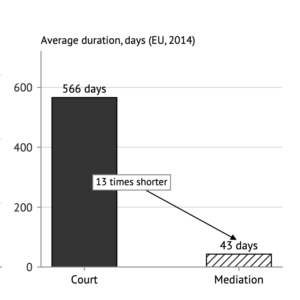
Court is costlier and slower than mediation. Experts from 26 EU countries priced the same hypothetical commercial dispute: on average €10,449 in court against €2,497 in a successful mediation, 566 days against 43.
Winning is not the same as collecting. The World Justice Project index rates how effectively civil judgments are actually enforced: across 35 OECD countries the score is 0.66 out of 1; in Ukraine, 0.47. By national data for 2025, of UAH 2.32 trillion of debt in enforcement proceedings, UAH 29.6 billion was actually recovered: 1.3 kopecks per hryvnia. Those are all debts, not partnership disputes, but the gap between a judgment and the money is visible even in prosperous countries.
The legal layer is needed. It is an insurance policy: while the partnership lives, it lets the partners invest in the shared business knowing that, in the worst case, protection exists. But the policy pays out only when the partnership has already ended in failure. The legal layer is the lifeboats. Having them does not mean the ship will sink. But lifeboats do not steer the ship.
Check your document: five signs
- Provisions are written as intentions: “we act openly,” “we support each other.” The enforceable layer is missing. Separate declarations from obligations; for each obligation, set the action, the deadline, and the consequence of non-performance.
- One lawyer drafted the document for both. Neither partner has an independent legal position, and in a conflict the attorney must withdraw. If it goes to court, each of you will need your own attorney.
- A standard template was signed, and the scenarios were never discussed: powers, money, deadlock, entry and exit. The governance layer is missing; the document has nothing to record. Agreements first, formalization second.
- There is no exit procedure, share valuation, deadlock resolution, or jurisdiction clause. The war-contingency layer is missing. That is the lawyer’s job: a corporate agreement with an enforceable part.
- “If anything happens, we’ll go to court” is the plan. Three steps of enforcement are counted as one. Assess the feasibility of each separately: the odds of reaching court, its cost and duration, the enforceability of the judgment.
Three things instead of one word
Back to the two partners from the beginning. Their documents were in order. What was not in order was everything the documents were silent about: who expects what, what counts as fair, how to revise the terms when life changes. The lawyer did not ask, because that is not the lawyer’s subject. The partners did not agree on it, because they thought the contract was the agreement.
The agreement is worked out by the partners. The document records it, and the signature under it is their act of will: acknowledgment, promise, reference point. The contract is made out of the enforceable part by a lawyer, and where the partnership meets the state, the lawyer is irreplaceable.
A contract is not the source of the agreements but their witness. If there is nothing to bear witness to, a lawyer will not help. If there is, the lawyer will do the job better than ever.
This text is a short version of my article on Zenodo, Agreement Between Partners: Three Layers, Four Functions, and the Limit of Legal Formalization. The full version has what is deliberately left out here: the corpus measurements with reproducible queries, the analysis of Ukrainian law with the articles of the code and Anglo-American parallels, the source of every figure with its sample and measurement conditions, the lawyers’ objections and the answers to them. The article is published in English, Ukrainian, and Russian.