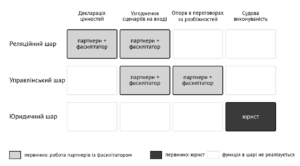
The seventh article in a series based on the paper “Partnership Agreement: Three Layers, Four Functions, and the Limits of Legal Formalization.” The previous one was about why one lawyer cannot defend both partners. This one is about what actually stands behind the words “if anything goes wrong, we’ll go to court.”
“If anything goes wrong, we’ll go to court”
When partners discuss whether it is worth spending time on agreements, one of them usually says: “If anything goes wrong, the court will sort it out.” The phrase sounds like a plan. In fact, it hides three separate steps, and at each of them the outcome depends on people the partners never chose: a judge, an enforcement officer, a bank. Below: what these steps are, why most disputes never reach them, and what follows from this for a partnership agreement.
The norm obliges, the apparatus enforces
A legal norm creates an obligation. In the reading of legal philosopher Herbert Hart, law is not a command backed by the threat of punishment, as John Austin held, but a rule that obliges. The force behind the norm, however, comes from the apparatus that applies it, and that apparatus is the state.
For partners this means a simple thing: any coercion in their dispute ultimately becomes state coercion. Ukrainian law assigns compulsory enforcement to the State Enforcement Service and, in cases provided by law, to private enforcement officers (Part 1 of Article 16 of the Law of Ukraine “On Bodies and Persons Carrying Out Compulsory Enforcement of Court Decisions and Decisions of Other Bodies”; Part 1 of Article 5 of the Law of Ukraine “On Enforcement Proceedings”).
Private enforcement officers, in turn, exist only because the state allows them to. Partners may agree on “our own arbitrator” or an arbitration tribunal. But it is still the state that enforces the award by force.
Three steps
Step one: obtain a decision. It comes from a court or an arbitration tribunal. A corporate dispute between the members of a company is heard by the commercial court at the company’s location, followed by possible appeal and cassation. At this step, each partner needs a lawyer of their own, as discussed in the previous article of the series: “One Lawyer Cannot Defend Both: Why the Legal Formalization of a Partnership Is Adversarial by the Rules of the Profession Itself.”
Step two: give the decision enforceable force. A court decision must enter into legal force, after which the court issues an enforcement document: a writ in commercial proceedings or a writ of execution in civil proceedings. It is the enforcement document, not the decision, that serves as the basis for coercion (Article 3 of the Law “On Enforcement Proceedings”). An arbitration award is not enforced on its own: the winning party goes to a state court for a writ (Articles 351–356 of the Commercial Procedure Code of Ukraine; Articles 483–487 of the Civil Procedure Code of Ukraine). A foreign arbitral award must first be recognized by a Ukrainian court (Articles 474–482 of the Civil Procedure Code of Ukraine). Without this step, the decision remains a piece of paper that is complied with only voluntarily.
Step three: achieve actual enforcement. The enforcement document reaches a state or private enforcement officer, and from there everything depends on whether the debtor has assets and money, whether the officer finds them, and how quickly the bank complies with the officer’s demand. The officer has a queue of cases, the bank has regulatory requirements, and the debtor has time to prepare.
An example. A partner left the company, and the court awarded him the value of his share. The decision entered into force, the writ was issued, and the enforcement officer opened proceedings. The company’s accounts are empty: over the year of the dispute, its turnover was moved to another company founded by the former partner. The officer seizes what he can find, while recovery from the new company requires a new lawsuit and another round of the same three steps. The situation is typical.
At each step, the outcome depends on procedure, evidence, and third-party decisions. A partner who says “we’ll go to court” usually means the first step and does not think about the next two.
The court works as a shadow
Most coercion happens without a single step. Parties comply with their agreements because they understand what happens if they do not: they act in the shadow of the law. Robert Mnookin and Lewis Kornhauser described this as bargaining in the shadow of the law, discussed earlier in the article on the four functions of an agreement.
Two conclusions follow. The rarity of trials does not prove that the court is useless: it works through threat, not procedure. But an expensive and imperfect machine casts the shadow. The costlier the process and the worse the enforcement, the weaker the shadow, and the less it restrains a partner who has decided not to honor the agreement.
The vanishing trial
American statistics show how rare a trial is: they have been kept for a long time and consistently. In US federal courts, of 407,379 civil cases terminated in fiscal year 2025, 1,681 reached trial, that is, 0.4%. In 1962 the figure was 11.5%. Legal scholar Marc Galanter called this phenomenon “the vanishing trial,” which is also the title of his paper.
Two caveats to this number. First: it is the share among cases that have already reached court, not among all conflicts. Second: in 2025 the denominator is inflated by the mass litigation over 3M earplugs; a single district in Florida terminated 149,259 such cases, 11 of them by trial. Without it, the share would be 0.65%. The remaining cases did not necessarily end in settlement: many were closed on procedural grounds or decided by a judge without trial. But even for those already in court, a trial on the merits is the exception.
The layer for the case of war
A lawyer translates the partners’ agreements into constructions a court will accept: sanctions, security, a procedure for forced exit, jurisdiction. Whether a construction is needed, and on what terms, is for the partners to decide. Let us call this part of the agreement the layer for the case of war. While the partnership is alive, it works like an insurance policy: the partners invest in the common venture knowing that protection exists for the worst case. But the payout under the policy comes only when the partnership ends in failure, and it comes through the three steps described above.
The provisions that work every day belong to a different layer: who does what, how decisions are made, how deadlocks are resolved, how exit is agreed. This is the management layer, and it holds the partnership together while it lives. The layer for the case of war is needed. But what makes a partnership workable is not that layer; it is the agreements the partners have worked out themselves.
What this means for partners
“We’ll go to court” is three steps, not one. A decision, an enforcement document, recovery. At each step, third parties decide, and at each step one can be left with a decision in hand and no money.
The shadow of the court restrains as long as the process is not too expensive. The longer and costlier the path through the three steps, the less a partner fears breaking the agreement. Enforceable provisions strengthen the shadow but do not replace it.
Formalize the layer for the case of war, but do not build the partnership on it. Sanctions and security kick in when the partnership is already over. Management agreements hold daily work together, and they do not need a court.