The fifth article in a series based on the paper “Agreement Between Partners: Three Layers, Four Functions, and the Limit of Legal Formalization.” The previous one took apart the four functions of an agreement. This one is about why partners should sign an agreement that a court, for the most part, will not enforce.
“Why sign it, if it is not a legal document?”
The question is a fair one if you look at a signature only as a condition of legal force. In that case, a signature under a text that a court will not enforce really is pointless.
In November 2024, I published an ironic post on LinkedIn titled “Never, never, never sign a partners’ agreement,” with five “arguments” for living without agreements. Among them: the market never changes, trust solves every problem, and human memory never fails, so everyone remembers in the same way what was agreed six months ago. The post gathered more than 15,000 views and a few dozen comments. This article is a serious answer to the same question: why sign.
A signature under a partners’ agreement does four things, and the legal one is the last of them. The first three work from the first day of the partnership and until a conflict. The fourth works only in a conflict, and for this signature it is incidental.
Acknowledgment: discussed does not mean agreed
An example. Two partners are discussing over dinner how they will split the annual profit. One proposes sixty-forty, because he puts in more time. The other replies: “Makes sense.” That is where the conversation ends. Six months later, the first calculates the profit sixty-forty. The second is surprised: he thought they had merely discussed one of the options, not made a decision.
Neither of them is lying. They remember the same conversation differently, because discussion and agreement look alike until action is needed. By signing, a partner says: this is not just a conversation; these are our agreements. I understand them, I agree with them, I accept them, and I am ready to carry them out.
In the previous article in the series, “Four Functions of a Partners’ Agreement: Law Serves Only One,” the second function, agreeing on future scenarios, is described through Lon Fuller’s cautionary function of form: having to formulate and sign creates a pause in which a person checks whether they are ready to do what they are signing. Until there is a signature, one partner considers the matter settled, and the other considers it merely discussed.
A promise to a partner
The second thing a signature does is make a promise. The person sitting next to you receives it and signs the same thing.
Do promises work without enforcement? This has been tested experimentally. In their 2006 paper “Promises and Partnership,” the economists Gary Charness and Martin Dufwenberg gave participants in a trust game the opportunity to exchange messages before the game began. Those who promised to cooperate did so much more often, and those who received a promise trusted more often. The game had no enforcement: a promise could be broken without consequences.
In his 2008 paper “Why Do People Keep Their Promises?” Christoph Vanberg examined why this happens. Two explanations competed: people keep a promise because they do not want to let down the other person’s expectations, or because they made it. The experiment supported the second. A promise binds as an act, regardless of what the other side expects.
A signature under a partners’ agreement is a written promise that can be reread, and it is mutual: each partner gives it to the same people from whom he receives it.
A reference point: what we argue from
The third thing a signature does is fix the text as the starting point for the partners in a dispute.
A signature fixes not only the content but also the currency: this particular version is the one in force. Hence a rule worth fixing separately: amended agreements are re-signed.
An example. Under the signed agreement, the partner who runs operations receives a monthly fee for it on top of his share of the profit. A year later, when money was short, the partners verbally agreed to stop the fee. Nothing was changed in the agreement. Two years later, the business reached stable profits, and the first partner raises the question of restoring the fee: they had agreed to stop it while money was short. The second objects: they agreed to cancel it, because the profit share already covers his work. The signed text is on the first partner’s side. Each remembers the verbal agreement differently: one with a condition, the other without it. A re-signed version with a condition or a term would have settled the question.
The legal function: the only visible one, and incidental for this signature
The fourth thing a signature does is the legal function. It is what people have in mind when they treat a signature as an act with consequences, and they fail to notice the first three behind it.
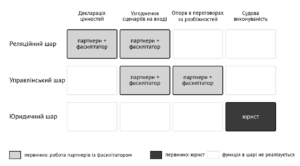
For a partners’ agreement, it is incidental. The enforceable layer is drafted later by a lawyer, in separate documents: the charter, the corporate agreement, the share purchase agreement. There, the signature becomes a condition of written form (Article 207(2) of the Civil Code of Ukraine), and without written form a corporate agreement is void.
However, one consequence of signing a partners’ agreement is worth noting. The law allows the parties to choose the form of a transaction themselves, unless the law requires otherwise (Article 205 of the Civil Code of Ukraine). A court interprets the content of a transaction by its words, the intentions of the parties, and its purpose, not by the title of the document (Article 213 of the Civil Code of Ukraine). So if the signed agreement contains a provision specifying who must do what and for whose benefit (Article 509 of the Civil Code of Ukraine), a court may recognize it as an obligation regardless of whether the cover says “agreement,” “charter,” or “memorandum.” This is worth knowing so that you do not write into the agreement anything you are not ready to carry out.
Three functions work every day; the fourth, only in a conflict
The first three functions of a signature (acknowledgment, promise, and reference point) operate throughout the life of the partnership, from the first day. The legal one switches on at full strength when the partnership is already in conflict, that is, in the very scenario that working out the agreements is meant to avoid.
The legal function matters. But behind it, the other three go unseen, and it is they that determine the quality of work in a partnership.
What this means for partners
Sign. A signature separates agreement from discussion: until then, each partner has their own version of what was agreed.
Re-sign. Every amended agreement. Otherwise, the reference point goes stale, and in a dispute each partner cites their own version.
Sign only what you are ready to carry out. A provision that specifies who must do what and for whose benefit may be recognized by a court as an obligation regardless of the document’s title. If the partners want to make some of their agreements enforceable in court, they bring in a lawyer, and those agreements are drawn up in separate documents for exactly that purpose.