When pondering what constitutes success in business, we typically start listing clichéd phrases: having a breakthrough idea, having capital, “people are the key,” “who before what,” “identifying customer pain points and offering solutions,” having connections and patrons. All of the above are certainly important and play a significant role in business success, but an important resource remains behind the scenes, one that essentially underpins business as a whole—trust.
Nobel laureate in economics in 1972, Kenneth Arrow, noted that “virtually every commercial transaction contains an element of trust… Much of the economic backwardness in the world can be explained by the lack of mutual trust.” Indeed, when we say that there is a favorable business environment somewhere, what do we mean by that?
We mean that the state trusts businesses regarding tax payments and doesn’t burden them with endless inspections; banks trust businesses by reasonably assessing risks and offering adequate interest rates; suppliers trust and can provide trade credit. Even within a company, employees receive their salaries not in advance and not daily, trusting their employer and willing to wait until the end of the month. A buyer trusts the seller when purchasing goods online, expecting delivery; a homebuyer trusts the developer when purchasing a house at the construction stage; a business angel trusts the founders. There are many such examples.
If trust is so important, how can it be assessed or correlated with economic growth and wealth? Economist Yann Algan conducted such a study based on data from the General Social Survey, conducted by the National Opinion Research Center at the University of Chicago, which has been conducted since the end of the 19th century. The survey provides information on the level of trust among Americans and the countries from which their ancestors came, with almost all European countries included in the study. Sweden was chosen as the control country. Respondents were asked:
“Do you agree that most people can be trusted, or do you think that you need to be very careful in dealing with people?”
Algan found that in 1935, Americans whose ancestors came from France, England, and Germany were more inclined to trust others (by 4%, 4.3%, and 2.4% respectively, compared to descendants from Sweden). In contrast, in the same period, descendants of immigrants from the Mediterranean, Latin America, Africa, and India were significantly less trusting.
Interestingly, when analyzing data from 2000, the level of trust among immigrants whose ancestors came to the US from Western Europe sharply declined. The descendants of immigrants from France and the UK were 4.7% less likely to trust others. A similar trend was observed among immigrants from Eastern Europe. Meanwhile, descendants of immigrants from Northern European countries showed greater trust in 2000 compared to 1935.
Algan suggests that these changes can primarily be explained by the fact that immigrants whose descendants were surveyed in 1935 arrived in the US before both World Wars. The increase in trust among the Nordic nations, particularly the Swedes, is partially explained by their relatively low losses during both World Wars.
In his study “Inherited Trust and Growth,” Algan concludes that about 45% of all changes in per capita income in the studied countries can be explained by the effect of trust.
Using Sweden as a reference point, Algan shows that if the level of trust among people of African descent were similar to that among Swedes, the average per capita income in Africa would increase by up to 546%.
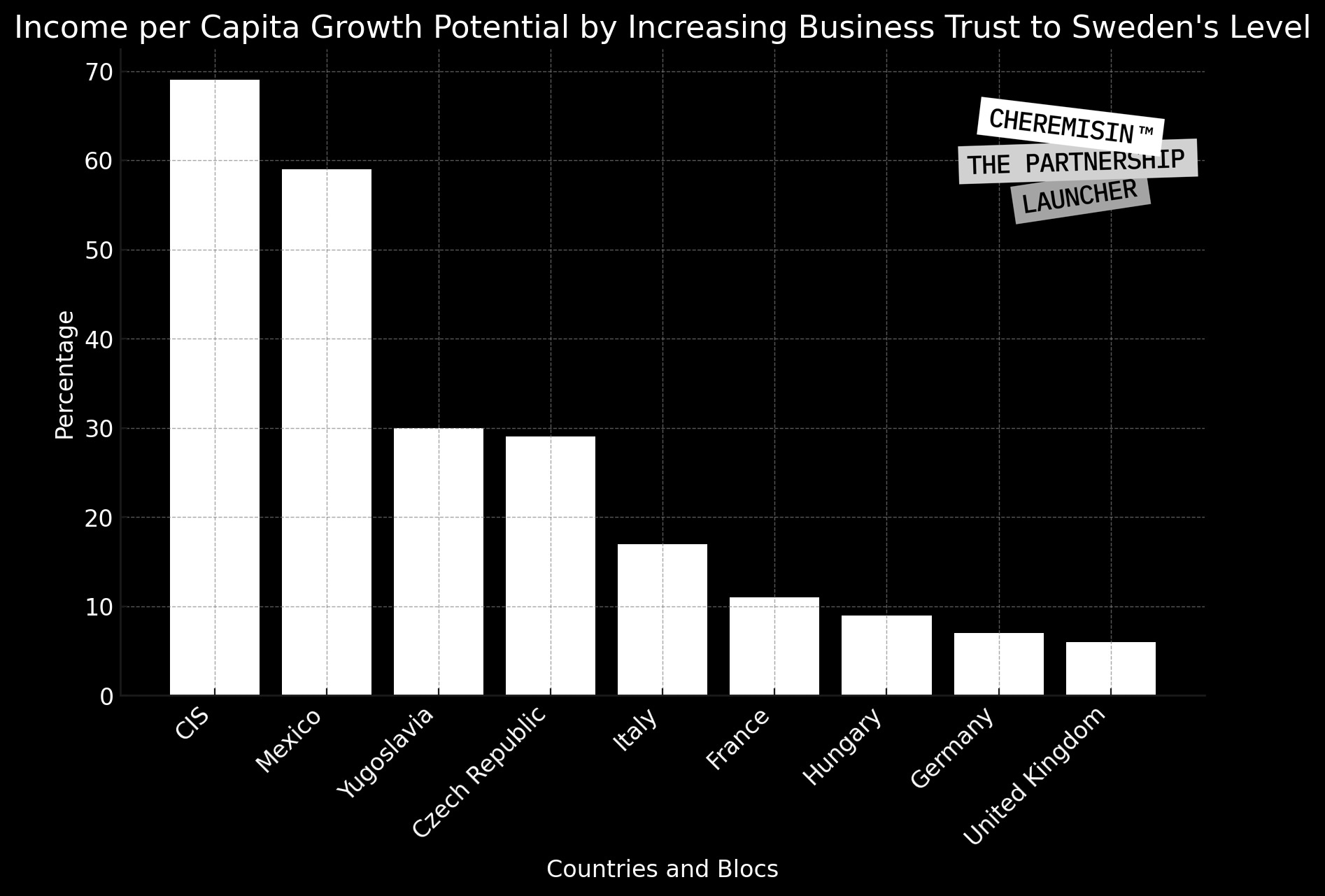
It is fair to note that any study concerning Africa faces the effect of a low base, and almost any improvements can lead to staggering results. However, according to Algan’s calculations, other countries also have significant potential for growth in per capita income:
- CIS – 69%
- Mexico – 59%
- Yugoslavia – 30%
- Czech Republic – 29%
- Italy – 17%
- France – 11%
- Hungary – 9%
- Germany – 7%
- United Kingdom – 6%
If the potential for economic growth, measured in tens of percent, lies in trust, how can trust be managed and increased? A study led by economist Alexander Auzan, “Trust in Business,” shows that the main pillar on which trust in the business environment is built is the institution of contracts. Drafting and negotiating a contract for large deals can sometimes take months. A contract creates significant confidence among counterparties in fulfilling obligations. In the absence of a judiciary system based on precedent law, capable of impartially resolving disputes, detailed contractual terms are the main element of formal protection for business partners’ interests.
Human history has overcome the path from hostages to collateral, from collateral to 100% prepayment, from 100% prepayment to contract performance guarantees. The word “contract” comes from the Latin word “contractus,” which, in turn, is derived from the verb “contrahere.” This verb consists of the prefix “con-” (meaning “together”) and the verb “trahere” (meaning “to pull”). Thus, “contractus” literally means “pulled together.”
Applying the above to the practice of joint ownership and management of a business, it must be recognized that a partnership agreement is an effective tool for increasing trust in a joint business. Trust is achieved through a detailed discussion of an exhaustive list of questions during partnership alignments. Trust based on a contract that leaves no room for ambiguity is the most important asset for partners, allowing them to implement complex long-term programs and lead co-owners to high achievements in the tough, competitive environment of modern business.
Summary: Trust plays a key role in business success, providing a stable foundation for commercial transactions and interactions at all levels, from the internal workings of a company to global economic relations, significantly influencing economic growth and prosperity.